Elon Musk reposted

QC
@QiaochuYuan
this is a very sobering read. main thesis is in section 5:
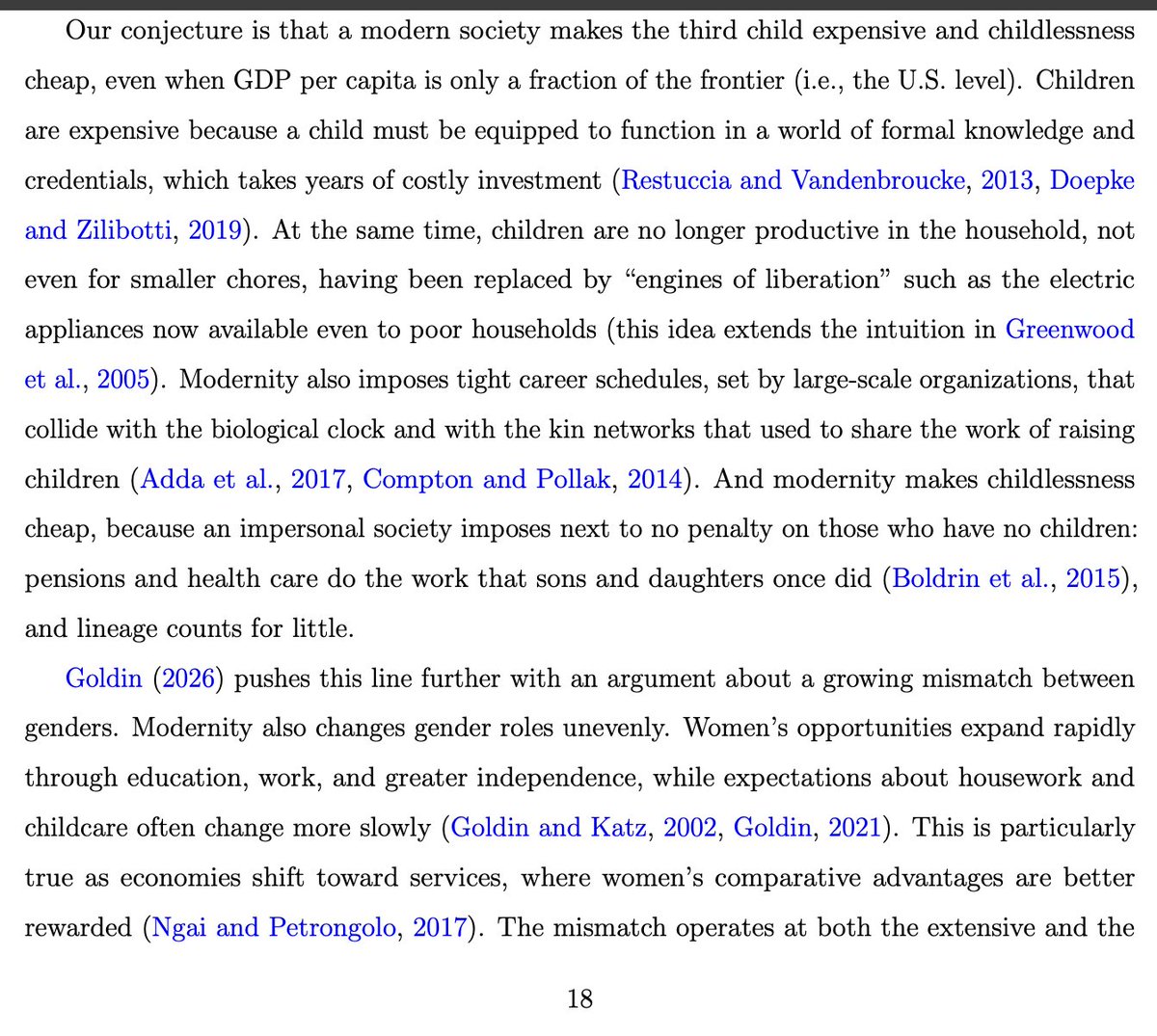
> Our conjecture is that a modern society makes the third child expensive and childlessness cheap, even when GDP per capita is only a fraction of the frontier (i.e., the U.S. level). Children are expensive because a child must be equipped to function in a world of formal knowledge and credentials, which takes years of costly investment (Restuccia and Vandenbroucke, 2013, Doepke and Zilibotti, 2019). At the same time, children are no longer productive in the household, not even for smaller chores, having been replaced by “engines of liberation” such as the electric appliances now available even to poor households (this idea extends the intuition in Greenwood et al., 2005). Modernity also imposes tight career schedules, set by large-scale organizations, that collide with the biological clock and with the kin networks that used to share the work of raising children (Adda et al., 2017, Compton and Pollak, 2014). And modernity makes childlessness cheap, because an impersonal society imposes next to no penalty on those who have no children: pensions and health care do the work that sons and daughters once did (Boldrin et al., 2015), and lineage counts for little.
> Goldin (2026) pushes this line further with an argument about a growing mismatch between genders. Modernity also changes gender roles unevenly. Women’s opportunities expand rapidly through education, work, and greater independence, while expectations about housework and childcare often change more slowly (Goldin and Katz, 2002, Goldin, 2021). This is particularly true as economies shift toward services, where women’s comparative advantages are better rewarded (Ngai and Petrongolo, 2017). The mismatch operates at both the extensive and the 18 intensive margins: more women remain childless, and mothers have fewer children on average.
> This argument is attractive because it explains why East Asia and now Latin America have such low TFRs. These are the societies where the gender mismatch is largest.19 It also suggests an intriguing possibility: societies with highly unbalanced gender norms start with very high TFRs, as men impose their preferences (Ashraf et al., 2014), and end with very low ones, as women resist (Doepke and Kindermann, 2019, Doepke and Tertilt, 2018). A paradoxical reversal of demographic fortunes.
...
> In short, modernity in its current form seems largely incompatible with replacement-level fertility.


 Jesús Fernández-Villaverde@JesusFerna7026· Aug 18, 2026
Last week I posted a new paper with Patrick Norrick: “Terra Incognita: The Economics of a Shrinking World.”
We chose the title deliberately. No society in history has experienced the fertility levels now seen in South Korea, China, Thailand, Colombia, Chile, and many other

09:42 PM · August 19, 2026 · 361.9K views
79
293
2.3K